
What is Robotic Sensors Market Size?
The global robotic sensors market size was valued at USD 770.11 million in 2025 and is projected to grow from USD 839.27 million in 2026 to approximately USD 1,858.46 million by 2035, registering a CAGR of 9.21% during the forecast period from 2026 to 2035. The market growth is primarily driven by the increasing adoption of robots across industries such as manufacturing, agriculture, healthcare, and logistics. Additionally, the growing integration of AI and IoT technologies with robotics is further accelerating the expansion of the robotic sensors market.
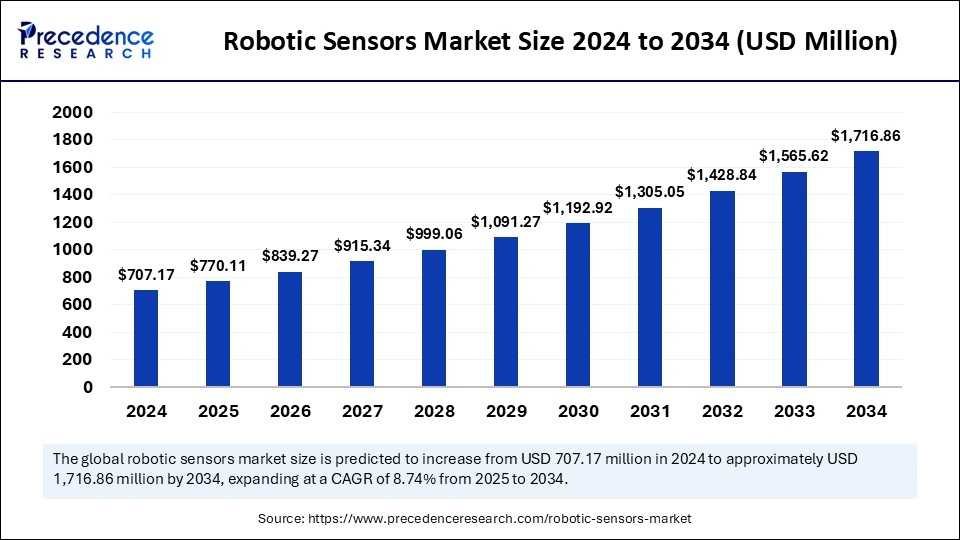
Get Sample : https://www.precedenceresearch.com/sample/5827
Market Highlights
- Asia Pacific dominated the global robotic sensors market in 2025
- North America is expected to witness the fastest growth during the forecast period.
- By sensor type, the vision sensors segment accounted for the largest market share in 2025.
- By sensor type, the force/torque sensors segment is projected to grow at the fastest rate during the assessment years.
- By application, the industrial robots segment dominated the market with the largest share in 2025.
- By application, the healthcare robots segment is set to register notable growth in the upcoming period.
- By technology, the MEMS-based segment contributed the highest market share in 2025.
- By technology, the optical segment is expected to expand at a significant growth CAGR in the upcoming period.
- By interface, the analog segment captured the biggest market share in 2025.
- By interface, the digital segment is anticipated to grow at the highest CAGR during the forecast period.
- By platform, the mobile robots segment held a significant market share in 2025.
- By platform, the industrial robots segment is projected to witness notable growth in the coming years.
Market Overview
The global robotic sensors market is witnessing significant growth due to the increasing adoption of robotics across various industries. The growing emphasis on automation has accelerated the use of robots in sectors such as logistics, healthcare, and automotive manufacturing. In addition, the rising focus on improving productivity, operational efficiency, and precision in manufacturing processes is further driving market expansion.
The growing demand for automation in the logistics and manufacturing sectors continues to support the adoption of robotic sensors. Furthermore, ongoing technological advancements have led to the development of advanced 3D sensors and tactile sensors, enhancing the capabilities of robots to perform complex tasks with greater accuracy and reduced time consumption. These innovations are playing a crucial role in strengthening the growth of the robotic sensors market.
Role of Artificial Intelligence in Robotics
The integration of artificial intelligence (AI) algorithms in robotics is significantly driving the expansion of the robotic sensors market. The incorporation of AI into robotic systems enhances accuracy, operational efficiency, and data-driven decision-making capabilities. AI enables robots to interpret and process large volumes of sensor-generated data, allowing them to perform tasks with greater precision and reliability.
AI-powered robots generate massive amounts of data, creating a growing demand for advanced sensors capable of efficiently analyzing and processing information to improve robotic functionality. In addition, technologies such as machine learning support real-time data analysis, enabling robots to adapt more effectively to dynamic and continuously changing environments. These advancements are further accelerating the growth and development of the robotic sensors market.
Market Scope
| Report Coverage | Details |
| Market Size in 2025 | USD 770.11 Million |
| Market Size in 2026 | USD 839.27 Million |
| Market Size by 2035 | USD 1,858.46 Million |
| Market Growth Rate from 2026 to 2035 | CAGR of 9.21% |
| Dominating Region | Asia Pacific |
| Fastest Growing Region | North America |
| Base Year | 2025 |
| Forecast Period | 2026 to 2035 |
Regional Insights
What Made Asia Pacific the Dominant Region in the Robotic Sensors Market?
Asia Pacific dominated the robotic sensors market with the largest share in 2025. This is mainly due to the rise in the adoption of robotics in industrial automation by countries like China, Japan, and India. These countries are investing heavily in AI-driven robotics due to the evolution of Industry 4.0. There is a heightened adoption of industrial robots in logistics and manufacturing industries. FANUC and Yasakawa are some of the leading robotics manufacturers in the region. Moreover, the rapid expansion of the electronics and automotive sectors further boosts market growth. The rise of AI-driven robotics and a strong emphasis on smart factories further support the market in the Asia Pacific.
What Makes North America the Fastest-Growing Region in the Robotic Sensors Market?
North America is expected to observe the fastest growth during the forecast period. The regional market growth is attributed to its robust industrial base with substantial investments in advanced manufacturing technologies and automation. There is a high adoption of robotics in industries like electronics, aerospace, and automotive. Additionally, the region is at the forefront of technological innovations, leading to the development of cutting-edge sensors that align well with AI and robotics applications.
What Potentiates the European Market?
The European robotic sensors market is growing as industries accelerate automation and smart manufacturing under Industry 4.0 initiatives, boosting demand for advanced sensing in automotive, logistics, and industrial applications. Strong manufacturing hubs in Germany, France, and Italy drive the adoption of precision sensors, while collaborative robots and safety standards further support integration. Increased investment in AI, IoT, and robotics innovation also fuels market expansion.
Value Chain Analysis
- Raw Material Sourcing
Raw material sourcing for robotic sensors relies on global supply chains for silicon, piezoelectric materials, rare earth elements, polymers, and metals, requiring stable procurement and quality control.
Key players: Bosch, TE Connectivity, Honeywell, Omron, and Keyence. - Component Fabrication and Machining
Robotic sensor component fabrication uses CNC machining to produce precise, complex parts such as casings and end-effectors from aluminum, plastics, or titanium, ensuring strength, accuracy, and consistency.
Key players: Fanuc, ABB, KUKA, Renishaw, and Rockwell Automation. - Testing and Certification
Testing and certification of robotic sensors include strict performance checks and compliance with global safety standards to ensure accuracy, reliability, and safe operation across diverse industrial environments.
Key players: TÜV SÜD, UL Solutions, Intertek, SGS, and Bureau Veritas.
Top Companies Operating in the Market & Their Offerings
- Fanuc Corporation: A global automation leader integrating advanced force, vision, and position sensors into its industrial robot systems to enhance precision, motion control, and vision-guided operations across manufacturing sectors.
- Baumer Group: Swiss sensor specialist providing compact, high-performance proximity, profile, and vision sensors that support robot positioning, quality inspection, and automated assembly tasks in smart manufacturing.
- Honeywell International Inc.: Offers robust industrial sensors and IoT-enabled sensing solutions that enhance robotic automation, predictive maintenance, and safety across automotive, electronics, and logistics applications.
Futek Advanced Sensor Technology Inc.: Develops high-precision force/torque, load, and torque sensors tailored for robotics, surgical systems, and automation where accuracy and sensitivity are critical. - ATI Industrial Automation Inc.: Supplies force/torque and multi-axis sensors that improve robot interaction with environments, enabling advanced control, collision detection, and precision force monitoring.
- Infineon Technologies: Semiconductor provider producing magnetic, Hall-effect, and Time-of-Flight sensing technologies used in robotic position, motion, and distance sensing for smart automation systems.
Recent Developments
- In June 2024, an innovative tactile sensor which is omnidirectional for robotic hands was launched by ETRI which detects pressure exerted by nay entity from any direction. These sensors further offer high precision and longevity as they are integrated with LED indicators and flexible air chambers.
- In June 2024, in India a leading player-HIKROBOT unveiled machine vision photoelectric sensors in India to strengthen its portfolio of robot sensors. It helps upgrade features of robotic sensors, like machine vision, resistance to climatic factors, and long-range detection.
Segments Covered in the Report
By Sensor Type
- Vision Sensors
- Force/Torque Sensors
- Inertial Measurement Units
- Encoders
- Laser Sensors
- Ultrasonic Sensors
By Application
- Industrial Robotics
- Healthcare Robotics
- Military and Defence Robotics
- Consumer Robotics
- Commercial Robotics
By Technology
- MEMS-based
- Optical
- Capacitive
- Inductive
- Piezoelectric
By Interface
- Analog
- Digital
- Wireless
- Fieldbus
By Robotic Platform
- Mobile Robots
- Industrial Robots
- Collaborative Robots
- Humanoid Robots
By Region
- North America
- Europe
- Asia Pacific
- Latin America
- Middle East and Africa (MEA)
Check this Report too : High-Bandwidth Memory Market
Get this report to explore global market size, share, CAGR, and trends, featuring detailed segmental analysis and an insightful competitive landscape overview @ https://www.precedenceresearch.com/sample/5827
You can place an order or ask any questions, please feel free to contact us at [email protected] |+1 804 441 9344