
What is the High-Bandwidth Memory Market Size?
The global high-bandwidth memory market size was valued at USD 7.27 billion in 2025 and is projected to grow from USD 9.18 billion in 2026 to approximately USD 69.75 billion by 2035, expanding at a CAGR of 25.37% from 2026 to 2035. The market is witnessing rapid growth due to the increasing demand for high-performance computing, artificial intelligence, data centers, and advanced graphics processing technologies. High-bandwidth memory (HBM) delivers faster data transfer speeds, lower power consumption, and improved processing efficiency, making it a crucial component for next-generation computing applications. Continuous technological advancements and the growing adoption of AI-driven workloads, gaming systems, and cloud computing infrastructure are expected to further accelerate market expansion in the coming years.
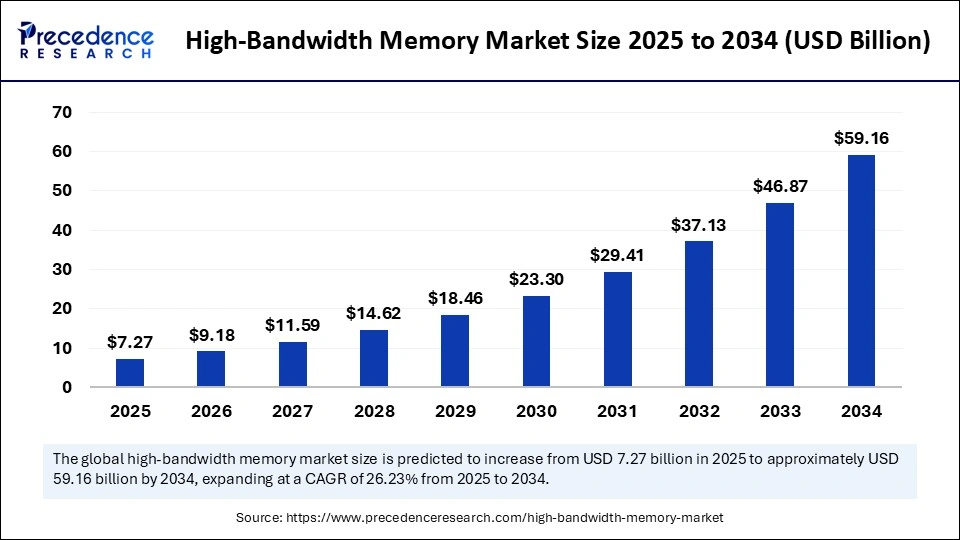
Get Sample : https://www.precedenceresearch.com/sample/6977
Market Highlights
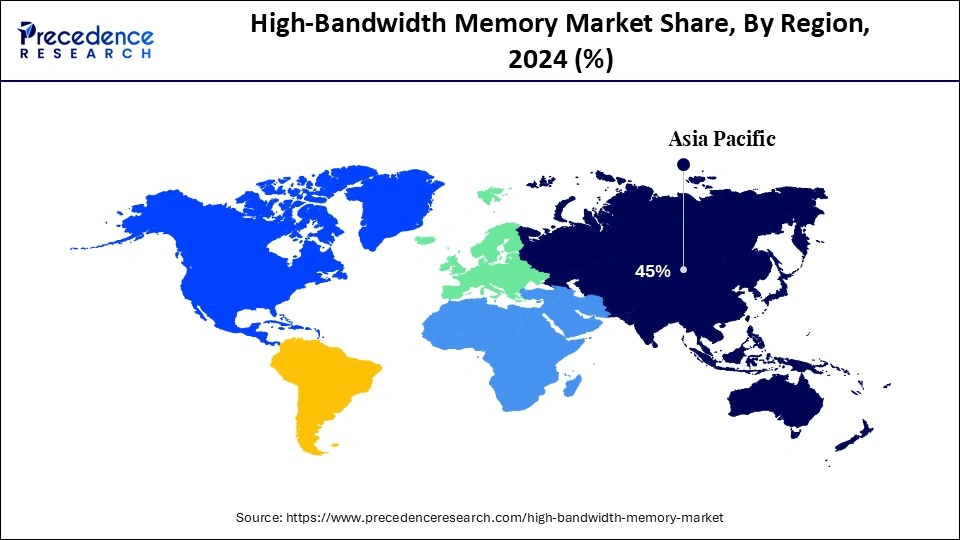
- Asia-Pacific dominated the market, holding largest market share of 45% in the year 2025.
- The North America is expected to expand at the fastest CAGR in the high-bandwidth memory market between 2026 and 2035.
- By application, the graphics processing units segment held the largest market share, accounting for 40% in 2025.
- By application, the artificial intelligence & machine learning segment is expected to grow at a significant CAGR between 2026 and 2035.
- By memory type, the HBM2 segment held the largest market share, at 50%, in 2025.
- By memory type, the HBM3 segment is expected to grow at a remarkable CAGR between 2026 and 2035.
- By end-user type, the semiconductors segment held the largest market share of 60% in 2025.
- By end-user type, the automotive segment is set to grow at a remarkable CAGR between 2026 and 2035.
Market Size and Forecast
- Market Size in 2025: USD 7.27 Billion
- Market Size in 2026: USD 9.18 Billion
- Forecasted Market Size by 2035: USD 69.75 Billion
- CAGR (2026-2035):25.37%
- Largest Market in 2025: Asia Pacific
- Fastest Growing Market: North America
What is the High-Bandwidth Memory Market?
The high-bandwidth memory market encompasses advanced memory technologies that offer higher data transfer rates and greater bandwidth compared to traditional DRAM. HBM achieves this by vertically stacking memory chips and using through-silicon vias (TSVs) to interconnect them, resulting in reduced power consumption and improved performance. HBM is primarily utilized in applications requiring intensive data processing, such as high-performance computing (HPC), artificial intelligence (AI), machine learning (ML), and graphics processing units (GPUs).
Market Key Trends in High-Bandwidth Memory Market
- Generational progression to higher stack counts and finer process nodes.
- Closer co-design between memory vendors and AI accelerator architects.
- Growth of heterogeneous integration (chiplet + HBM stacks) for modularity.
- Emphasis on power efficiency and thermal management at the module level.
- Vertical consolidation and strategic partnerships to secure packaging capacity.
Market Scope
| Report Coverage | Details |
| Market Size in 2025 | USD 7.27 Billion |
| Market Size in 2026 | USD 9.18 Billion |
| Market Size by 2035 | USD 69.75 Billion |
| Market Growth Rate from 2026 to 2035 | CAGR of 25.37% |
| Dominating Region | Asia Pacific |
| Fastest Growing Region | North America |
| Base Year | 2025 |
| Forecast Period | 2026 to 2035 |
Regional Insights
What is the Asia Pacific High-Bandwidth Memory Market Size?
The Asia Pacific high-bandwidth memory market size is evaluated at USD 3.27 billion in 2025 and is projected to be worth around USD 31.78 billion by 2035, growing at a CAGR of 25.53% from 2026 to 2035.
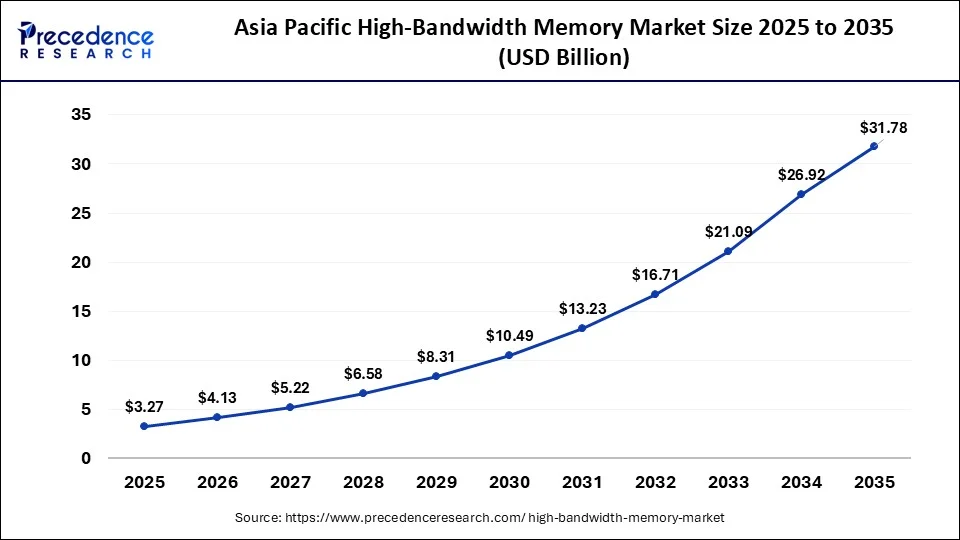
How is Asia Pacific the Rising Star in the High-Bandwidth Memory Market?
Asia Pacific is dominating the high-bandwidth memory market, driven by its deep semiconductor manufacturing base, agile OSAT ecosystem, and substantial capital commitments to advanced packaging capacity. The region’s foundries and assembly houses are rapidly scaling wafer-level stacking and interposer production capabilities to meet global demand. Moreover, Asia Pacific’s growing cadre of AI hardware start-ups and system integrators is broadening local adoption and accelerating co-design efforts. Cost advantages in fabrication and assembly, combined with a coordinated industrial policy, create fertile ground for rapid capability improvement. As a result, the Asia Pacific is not merely a manufacturing hinterland but an increasingly strategic locus of packaging innovation and scale.
Country Analysis China
China’s expansive semiconductor ambitions and manufacturing scale make it a focal point for HBM capacity growth and vertical integration. Investments in OSATs, interposer fabs, and domestic DRAM capability are accelerating, aimed at reducing reliance on external supply chains. With strong domestic demand from cloud providers and AI hardware firms, China is positioning itself to become both a major consumer and producer of high-bandwidth memory solutions contingent on continued technological catch-up and ecosystem partnerships.
How is North America the Fastest Growing in the In High-Bandwidth Memory Market?
North America is the fastest-growing region in the high-bandwidth memory market ecosystem, driven by demand and system integration leadership, anchored by hyperscale cloud providers, AI accelerator designers, and leading GPU/IP houses. The region’s strength lies in its end-user demand for the highest-bandwidth memory solutions, which are essential for cutting-edge AI training and inference platforms, combined with deep design capabilities for co-optimized memory-compute stacks. North American firms frequently secure early access to roadmap modules through strategic partnerships, and the concentration of data center demand incentivizes domestic investments in advanced packaging.
Value Chain Analysis
- Raw Material Sources: Primary inputs include DRAM-grade silicon wafers, high-reliability bonding materials, copper and tungsten for TSVs, and specialized substrate/interposer materials (silicon or organic). Supply chains also require high-purity chemicals and precision equipment for die thinning and wafer bonding steps.
- Technology Used: Core technologies include TSV formation, wafer-level bonding, micro bumps, silicon interposers, and advanced substrate engineering for signal routing. Complementary tools encompass thermal interface materials and microfluidic cooling integration. Test and verification employ high-speed electrical characterization, built-in self-test protocols, and environmental stress screening.
- Investment by Investors: Investors channel capital into OSAT expansions, interposer fabrication fabs, and specialized packaging start-ups, often via strategic corporate partnerships and long-term offtake agreements with hyperscalers. Infrastructure and industrial funds occasionally co-finance high-capex facilities where sovereign or supply-security objectives align.
- AI Advancements: AI accelerates yield and design optimization through predictive models that forecast TSV failures, optimize thermal paths, and simulate signal integrity across complex interconnect topologies. Machine learning also speeds test-data analytics to triage marginal dies and improve overall assembly yields.
Company-wise Investments in the High-Bandwidth Memory Market
| Company | Approximate Investment Size | Nature / Purpose of Investment |
| SK Hynix Inc | US $74.5 billion | A broad semiconductor investment between now and 2028, ~80% of which is earmarked toward AI / HBM?related areas (capacity expansion, R&D) |
| SK Hynix | US$14.6 billion | Investment in a new fab in South Korea is targeted at boosting HBM output and related memory production capacity. |
| Micron Technology | US$200 billion | Nationwide U.S. initiative combining memory manufacturing and R&D, which includes advanced HBM packaging capabilities as part of the plan. |
| Micron Technology | US$7 billion | Investment in Singapore for memory chip manufacturing, including a new HBM advanced packaging facility. |
Other Major Key Players
- Samsung Electronics Co., Ltd.: Samsung is a major HBM producer, supplying HBM2E (Flashbolt) and HBM3 (Icebolt) memory for high-performance GPUs and AI accelerators. With deep expertise in DRAM fabrication and advanced 3D packaging, Samsung continues investing in HBM technologies for exascale computing and AI workloads.
- Advanced Micro Devices, Inc. (AMD): AMD integrates HBM memory into its Radeon™ GPUs and Instinct™ data center accelerators to reduce latency and improve energy efficiency. The company’s collaboration with SK Hynix and Samsung has positioned it as a key innovator in GPU-memory integration for AI and HPC systems.
- NVIDIA Corporation: NVIDIA is the largest consumer of HBM memory, utilizing it extensively across its A100, H100, and upcoming Blackwell GPUs. Through close partnerships with SK Hynix, Samsung, and Micron, NVIDIA drives innovation in HBM technology for AI training, inference, and advanced computing.
Recent Developments
- In October 2025, the investment bank raised its price target for the stock to $220, up from the previous $160, citing stronger-than-expected momentum in core DRAM, a key segment of memory chips. Analysts noted that Micron is likely to experience several consecutive quarters of double-digit price hikes, which they believe will significantly enhance the company’s earnings performance. (Source: https://finance.yahoo.com)
- In October 2025, Micron announced the sampling of its next-generation HBM4 memory, achieving a record 2.8 TB/s bandwidth rate, surpassing JEDEC’s earlier 2 TB/s target and outperforming competing HBM offerings from Samsung and SK Hynix. Micron also introduced a plan for a customizable “base logic die” (HBM4E variant) to allow customers like Nvidia and AMD to tailor memory stacks, which is expected to improve margins and lock in design win stickines. (Source: https://www.msn.com)
Segments Covered in the Report
By Application
- Graphics Processing Units (GPUs)
- High-Performance Computing (HPC)
- Artificial Intelligence (AI) & Machine Learning (ML)
- Networking & Data Centers
- Automotive (ADAS & Autonomous Driving)
- Consumer Electronics (Gaming Consoles, VR/AR)
- Others (e.g., Medical Imaging, Aerospace)
By Memory Type
- HBM1
- HBM2
- HBM2E
- HBM3
- HBM4
By End-User Industry
- Semiconductors
- Automotive
- Healthcare
- Telecommunications
- Consumer Electronics
- Others
By Region
- North America
- Europe
- Asia-Pacific
- Latin America
- Middle East & Africa
Check this Report too: Industrial Display Market
Get this report to explore global market size, share, CAGR, and trends, featuring detailed segmental analysis and an insightful competitive landscape overview @ https://www.precedenceresearch.com/sample/6977
You can place an order or ask any questions, please feel free to contact us at [email protected] |+1 804 441 9344