
The global magnetoresistive random access memory (MRAM) market size is calculated at USD 1.52 billion in 2025 and is predicted to increase from USD 2.19 billion in 2026 to approximately USD 16.46 billion by 2035, expanding at a CAGR of 25.1% from 2026 to 2035.
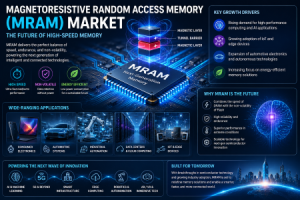
Understanding Magnetoresistive Random Access Memory Market Technology
MRAM is a non-volatile memory technology that stores data using magnetic states rather than electric charges. Unlike conventional RAM, MRAM retains stored information even when power is removed.
The technology relies on magnetic tunnel junctions (MTJs), where information is represented by the orientation of magnetic layers. This architecture provides several key advantages:
- Extremely fast read and write speeds
- Low power consumption
- High endurance and durability
- Non-volatility
- Resistance to radiation and harsh environments
- Longer lifespan compared to flash memory
These characteristics make MRAM suitable for mission-critical applications where reliability and performance are essential.
Key Factors Driving MRAM Market Growth
Rising Demand for High-Performance Computing
The growth of AI, machine learning, cloud computing, and big data analytics is creating unprecedented demand for high-speed memory solutions. Modern computing systems require memory technologies capable of processing vast amounts of information with minimal latency.
MRAM’s ability to provide fast access speeds while maintaining persistent storage positions it as an ideal solution for next-generation computing infrastructures. AI accelerators, edge computing devices, and high-performance servers increasingly require memory architectures that can reduce energy consumption while improving performance.
Expansion of Edge Computing and IoT
The rapid expansion of Internet of Things (IoT) devices has increased demand for low-power, reliable memory solutions. Smart sensors, industrial IoT equipment, wearables, and connected devices often operate in environments where power efficiency and data retention are critical.
MRAM enables instant-on functionality and preserves data during power interruptions, making it highly attractive for edge applications that require continuous operation.
Growing Adoption in Automotive Electronics
Modern vehicles rely heavily on electronic control units, advanced driver assistance systems (ADAS), autonomous driving technologies, and infotainment systems. These applications require robust memory capable of operating under extreme temperatures and demanding conditions.
MRAM’s durability, fast performance, and non-volatile characteristics make it particularly suitable for automotive electronics. As electric and autonomous vehicles continue to gain market share, MRAM adoption is expected to increase significantly.
Industrial Automation and Robotics
Industrial automation remains one of the largest end-use segments for MRAM technology. Robotics systems, manufacturing equipment, and industrial control systems require memory that can withstand harsh operating environments while maintaining high reliability.
MRAM’s endurance and resistance to power failures provide significant advantages in mission-critical industrial applications.
Increasing Demand for AI and Edge Computing Applications
Artificial intelligence (AI) and edge computing are driving significant demand for advanced memory technologies that can process data quickly while minimizing power consumption. MRAM offers high-speed performance, non-volatility, and low latency, making it ideal for AI workloads, machine learning algorithms, and edge devices. Unlike traditional memory solutions, MRAM can retain data even during power interruptions, enabling faster system startup and improved operational efficiency. As industries increasingly deploy AI-powered applications and edge computing infrastructure, the adoption of MRAM is expected to grow rapidly.
Growing Use of MRAM in Data Centers and Cloud Computing
Modern data centers and cloud computing environments require memory solutions that can handle large volumes of data with high reliability and energy efficiency. MRAM helps reduce power consumption while delivering faster read and write speeds compared to conventional storage technologies. Its high endurance and instant-on capabilities improve system performance and minimize downtime. As cloud service providers continue to expand infrastructure to support AI, big data analytics, and digital transformation initiatives, MRAM is emerging as an attractive solution for next-generation storage and memory architectures.
Major Applications of MRAM Across Industries
MRAM is finding applications across a wide range of industries due to its unique combination of speed, durability, and non-volatility.
- Consumer Electronics: MRAM is increasingly used in smartphones, wearable devices, tablets, and gaming systems to improve performance and battery life.
- Automotive Industry: Advanced driver assistance systems (ADAS), infotainment systems, and autonomous vehicle technologies benefit from MRAM’s reliability and ability to operate in extreme conditions.
- Industrial Automation: Factories and manufacturing facilities utilize MRAM in robotics, industrial controllers, and automation systems requiring continuous operation and data retention.
Magnetoresistive Random Access Memory Market Segmentation Analysis
By Technology Type
The MRAM market includes several technology categories:
- Spin-Transfer Torque MRAM (STT-MRAM)
- Toggle MRAM
- Spin-Orbit Torque MRAM (SOT-MRAM)
- Voltage-Controlled MRAM (VC-MRAM)
Among these, STT-MRAM holds the largest market share due to its superior scalability and power efficiency.
By Storage Density
The market is segmented into:
- Low-density MRAM
- Medium-density MRAM
- High-density MRAM
Medium-density MRAM currently dominates the market due to its balance between cost, capacity, and performance. However, high-density MRAM solutions are expected to witness the fastest growth as enterprise storage and AI applications continue expanding.
By Application
Key application areas include:
- Data logging and parameter storage
- Code storage and execution
- Working memory and cache replacement
- Buffer memory
- Persistent AI weights and edge inference
The emergence of AI workloads is creating substantial opportunities for MRAM, particularly in persistent AI memory architectures.
Get this report to explore global market size, share, CAGR, and trends, featuring detailed segmental analysis and an insightful competitive landscape overview @https://www.precedenceresearch.com/sample/3991
Regional Magnetoresistive Random Access Memory Market Outlook
Asia-Pacific currently dominates the global MRAM market and is expected to maintain its leadership throughout the forecast period. The region benefits from:
- Strong semiconductor manufacturing capabilities
- Expanding consumer electronics production
- Growing automotive electronics sector
- Significant investments in AI and cloud infrastructure
Countries such as China, Japan, South Korea, and Taiwan continue to invest heavily in semiconductor innovation, supporting regional MRAM adoption.
North America remains a major innovation hub for MRAM technology due to the presence of leading semiconductor companies, AI developers, cloud service providers, and research institutions.
Growing investments in data centers and advanced computing systems continue to create strong demand for next-generation memory solutions.
Europe’s focus on automotive electronics, industrial automation, and Industry 4.0 initiatives is expected to support steady MRAM market growth over the coming decade.
Read Also: Actuator Sensor Interface Market
Competitive Landscape
The MRAM market includes several prominent technology companies actively investing in research, development, and commercialization:
- Samsung Electronics
- Intel Corporation
- IBM Corporation
- SK Hynix
- Fujitsu
- Everspin Technologies
- Avalanche Technology
These companies are focusing on increasing storage density, reducing manufacturing costs, and enhancing compatibility with advanced semiconductor processes.
Challenges Facing the Magnetoresistive Random Access Memory Market
Despite its significant potential, MRAM faces several challenges:
High Manufacturing Cost: MRAM production remains more expensive than traditional memory technologies, limiting adoption in cost-sensitive applications.
Scalability Challenges: Although MRAM offers excellent performance, achieving high-density storage at competitive costs remains a technical challenge.
Competition from Emerging Memory Technologies: MRAM competes with other advanced memory technologies, including:
- Resistive RAM (ReRAM)
- Phase-Change Memory (PCM)
- Ferroelectric RAM (FeRAM)
Manufacturers must continue innovating to maintain competitive advantages.
Future Outlook
The future of the MRAM market appears highly promising. As AI systems, autonomous vehicles, edge computing devices, and industrial automation solutions become more sophisticated, demand for memory technologies that combine speed, durability, and energy efficiency will continue to rise.
Advancements in SOT-MRAM, embedded MRAM, and high-density architectures are expected to accelerate commercialization and reduce production costs. Furthermore, growing investments from semiconductor manufacturers indicate strong confidence in MRAM’s long-term potential.
𝐘𝐨𝐮 𝐜𝐚𝐧 𝐩𝐥𝐚𝐜𝐞 𝐚𝐧 𝐨𝐫𝐝𝐞𝐫 𝐨𝐫 𝐚𝐬𝐤 𝐚𝐧𝐲 𝐪𝐮𝐞𝐬𝐭𝐢𝐨𝐧𝐬, 𝐩𝐥𝐞𝐚𝐬𝐞 𝐟𝐞𝐞𝐥 𝐟𝐫𝐞𝐞 𝐭𝐨 𝐜𝐨𝐧𝐭𝐚𝐜𝐭 𝐮𝐬 𝐚𝐭 𝐬𝐚𝐥𝐞𝐬@𝐩𝐫𝐞𝐜𝐞𝐝𝐞𝐧𝐜𝐞𝐫𝐞𝐬𝐞𝐚𝐫𝐜𝐡.𝐜𝐨𝐦