
What is the Machine Vision Camera Market Size in 2026?
The global machine vision camera market size was valued at USD 52.50 billion in 2025 and is projected to grow from USD 59.85 billion in 2026 to approximately USD 194.63 billion by 2035, registering a CAGR of 14.00% during the forecast period from 2026 to 2035. The market is witnessing strong growth due to the increasing integration of artificial intelligence, advancements in 3D imaging technologies, and rising demand for automation across industries. Additionally, the expanding application of machine vision cameras in sectors such as surveillance, agriculture, healthcare, and industrial automation is further driving market expansion.

Key Takeaways
- North America dominated the market in 2025.
- Asia-Pacific is expected to grow at the fastest CAGR in the market during the forecast period.
- By type, the 2D vision segment led the global market in 2025.
- By type, the 3D vision segment is expected to expand rapidly in the machine vision camera market in the coming years.
- By product, the vision sensors and image-based barcode readers segment held a dominant position in the market in 2025.
- By product, the vision controllers segment is expected to grow with the highest CAGR in the market during the studied years.
- By application, the inspection segment accounted for the highest revenue share in the market in 2025.
- By application, the identification segment is expected to gain the highest share of the market between 2026 and 2035.
- By end user, the manufacturing segment held a major revenue share in the market in 2025.
- By end user, the automotive segment is expected to witness the fastest growth in the market over the forecast period.
What is the Machine Vision Camera Market?
A machine vision camera is an industrial camera designed for high-resolution imaging in automated inspection, measurement, and robotic guidance in manufacturing. These cameras feature high-speed image capture, global shutters, and interchangeable lenses for precise real-time analysis. These cameras are essential for inspection, quality control, robotics, and object recognition, focusing on image quality, consistency, and reliability. They also provide higher resolutions, faster frame rates, and reduced noise for detailed imaging.
In manufacturing, they are crucial for quality control, defect detection, dimension verification, assembly error identification, and compliance, thereby reducing waste and costs. In healthcare, they improve diagnostic accuracy and speed, reducing human error and aiding decision-making. Thus, machine vision cameras have revolutionized business operations, enhanced automation, accuracy, and efficiency across industries, enabling companies to streamline processes and improve quality control, helping gain a competitive edge.
What is the Role of AI in the Machine Vision Camera Market?
Artificial intelligence in machine vision cameras has transformed industrial operations by leveraging deep learning technologies to analyze visual data and enable faster, more accurate decision-making. AI-powered machine vision systems enhance traditional inspection methods by improving defect detection, object classification, and pattern recognition, even in complex industrial environments. These advanced systems outperform human inspectors in terms of speed and precision by identifying minute surface defects, color inconsistencies, and assembly errors, thereby reducing false positives, minimizing scrap rates, and improving overall operational efficiency.
Market Scope
| Report Coverage | Details |
| Market Size in 2025 | USD 52.50 Billion |
| Market Size in 2026 | USD 59.85 Billion |
| Market Size by 2035 | USD 194.63 Billion |
| Market Growth Rate from 2026 to 2035 | CAGR of 14.00% |
| Dominating Region | North America |
| Fastest Growing Region | Asia Pacific |
| Base Year | 2025 |
| Forecast Period | 2026 to 2035 |
Regional Insights
Which Factors Drive the Machine Vision Camera Market in North America?
North America held a major revenue share of the market in 2025, due to its early adoption of industrial automation, strong manufacturing capabilities, and significant investments in AI and robotics. This leadership is further fueled by a high demand for advanced inspection in the automotive and electronics sectors, a concentration of major vendors, and robust R&D efforts.
The region’s established automated production lines also require high-speed, 3D imaging technologies. Additionally, leading camera manufacturers and system integrators help shorten development times and speed up deployment. Swift investments in AI and edge computing enhance real-time decision-making and provide a competitive advantage to the industry.
How Will the Asia-Pacific Region Grow in the Machine Vision Camera Market?
Asia-Pacific is expected to host the fastest-growing market in the coming years, due to its large manufacturing base, rapid industrialization, and high automation. This growth is also driven by the need for precise quality control, robotic guidance, and AI inspection in the expanding electronics, automotive, and semiconductor sectors. As a global hub for production, the region needs advanced machine vision systems for quality assurance and defect detection. The market is further supported by strong government initiatives for smart manufacturing, which promote AI and machine vision technologies to enhance efficiency.
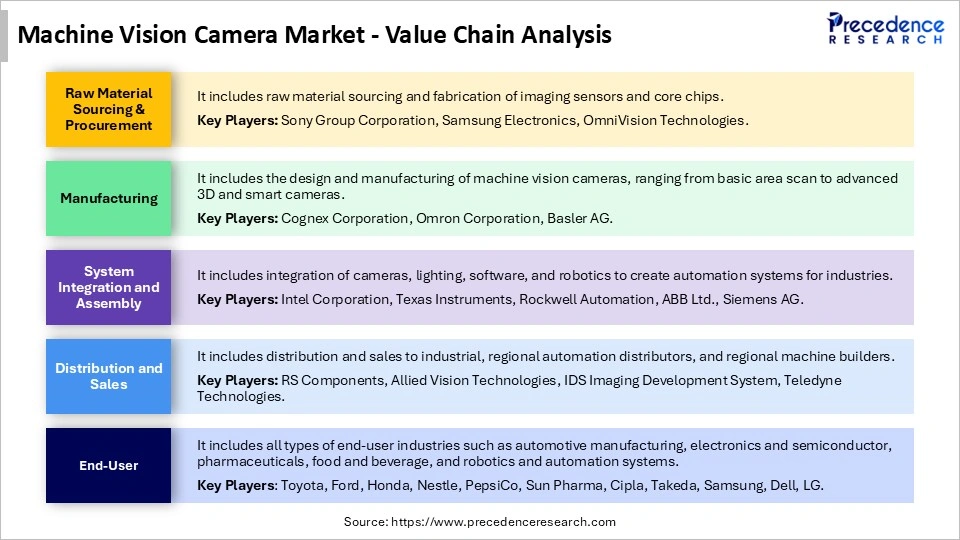
Machine Vision Camera Market Supply Chain Analysis
Machine Vision Camera Market Companies
- Cognex Corporation
- Keyence Corporation
- Teledyne Technologies Inc.
- Basler AG
- OMRON Corporation
- SICK AG
- Sony Group Corporation
- Allied Vision (TKH Group)
- Hikrobot
- Baumer Holding AG
- JAI A/S
- IDS Imaging Development Systems
- Datalogic S.p.A.
- Adimec Advanced Image Systems BV
Recent Developments
- In February 2026, Specim, a Konica Minolta subsidiary and leader in hyperspectral imaging, launched its FX19, a fast push hyperspectral camera operating in the NIR-SWIR spectrum of 1130–1920 nm. It offers improved performance and easy integration for industrial machine vision and advanced research, addressing the increasing demand for material identification and inspection in high-throughput environments.(Source: https://metrology.news)
- In September 2025, Keyence introduced its IM-X1000 Series, the newest addition to its Instant Measurement System range, for contemporary inspection requirements. It measures up to 5,000 dimensions in just one second with a single button press, boasting an ultra-wide stage, multisensor features, and the capability to automate intricate part programming.(Source: https://metrology.news)
Segments Covered in the Report
By Type
- D Vision
- 2D Vision
- 3D Vision
By Product
- PC-based Machine Vision System
- Vision Controllers
- Standalone Vision System
- Vision Sensors and Image-based Barcode Readers
- Others
By Application
- Identification
- Inspection
- Gauging
- Positioning
- Others
By End User
- Automotive
- Healthcare
- Manufacturing
- Industrial
- Others
By Region
- North America
- Europe
- Asia-Pacific
- Latin America
- Middle East & Africa
Check this Report too : Actuator Sensor Interface Market
Get this report to explore global market size, share, CAGR, and trends, featuring detailed segmental analysis and an insightful competitive landscape overview @ https://www.precedenceresearch.com/sample/8004
You can place an order or ask any questions, please feel free to contact us at [email protected] |+1 804 441 9344