
What is the Ceramic Facades Market Size in 2026?
The global ceramic facades market was valued at USD 7.99 billion in 2025 and is projected to grow from USD 8.56 billion in 2026 to approximately USD 16.01 billion by 2035, registering a CAGR of 7.20% during the forecast period from 2026 to 2035.
This growth is driven by the increasing demand for durable and energy-efficient cladding materials among architects and developers. Ceramic facades offer a strong combination of design flexibility, weather resistance, and long-term performance, making them a preferred choice for modern construction. Additionally, the rising adoption of sustainable building envelopes and the growing prominence of advanced ventilated facade systems are further contributing to market expansion.

Key Takeaways
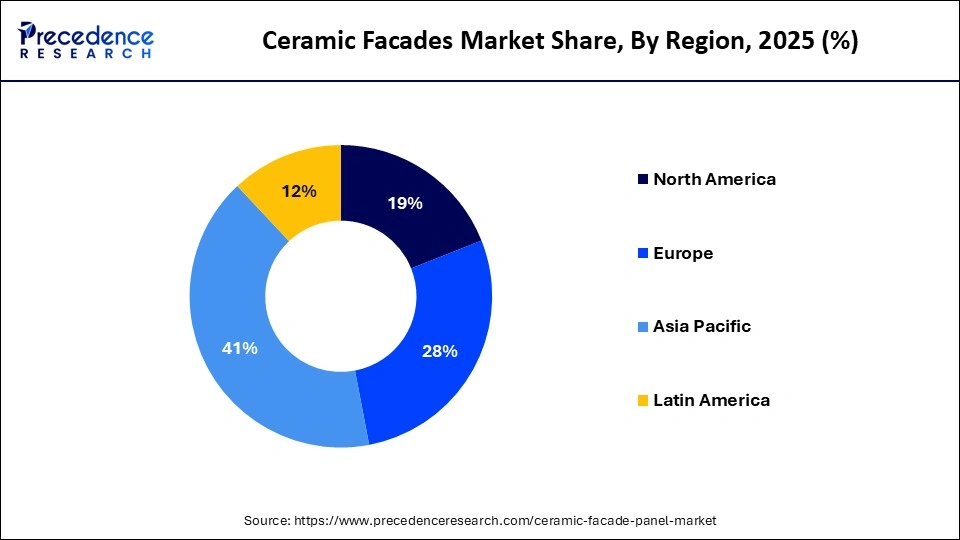
- Asia-Pacific held the largest revenue share of the ceramic facades market share of 41% in 2025.
- North America is expected to grow at the fastest CAGR in the market during the forecast period.
- By product type, the ventilated facade panels segment held the largest revenue share in the market in 2025.
- By product type, the non-ventilated facade panels segment is expected to grow at a significant CAGR in the market during the studied years.
- By application, the commercial buildings segment accounted for the highest revenue share in the market in 2025.
- By application, the residential buildings segment is expected to witness the fastest growth in the market over the forecast period.
- By installation method, the curtain wall segment held the largest revenue share in the market in 2025.
- By installation method, the cladding segment is expected to grow at the fastest CAGR in the market between 2026 and 2035.
What is the Ceramic Facades Market?
The ceramic facades industry involves the design, manufacturing, and installation of exterior cladding systems that serve both protective and aesthetic purposes in modern buildings. These facades are typically made from materials such as terracotta, porcelain, or engineered ceramics, which are mounted onto sub-structures to create a ventilated cavity between the facade and the structural wall. This design enhances airflow, improves insulation, and helps regulate indoor temperatures while protecting buildings from moisture, ultraviolet (UV) radiation, and environmental contaminants.
Ceramic facades have become a preferred choice across commercial skyscrapers, cultural institutions, transit hubs, and premium real estate developments, where both durability and architectural appeal are essential. Unlike traditional cladding materials that may fade or require frequent maintenance, ceramic surfaces retain their color and structural integrity for decades, offering lower lifecycle costs and long-term value for investors.
With the global shift toward sustainable construction and energy-efficient building designs, the adoption of ceramic facades is steadily increasing. Architects and developers are increasingly favoring these systems for their ability to seamlessly combine functionality, aesthetics, and environmental performance.
Impact of AI on the Ceramic Facades Market
Artificial intelligence (AI) is transforming the way ceramic facade systems are designed, manufactured, and maintained throughout the lifecycle of buildings. At architectural firms, AI-assisted parametric modeling enables designers to predict airflow patterns, solar radiation exposure, and structural loads before fabricating any panels. This process contributes to shaping the geometry of facades for enhanced performance and aesthetics.
Moreover, manufacturing plants are also using computer vision systems that inspect ceramic panels for small cracks, inconsistencies in glazing, or any dimensional defects, increasing quality control and minimizing material waste. AI is also being applied in building operations; such sensor-integrated façade systems provide real-time data to predictive maintenance platforms. This feature enables the early detection of structural wear or thermal inefficiencies, facilitating managers to resolve issues before significant damage occurs.
Market Scope
| Report Coverage | Details |
| Market Size in 2025 | USD 7.99 Billion |
| Market Size in 2026 | USD 8.56 Billion |
| Market Size by 2035 | USD 16.01 Billion |
| Market Growth Rate from 2026 to 2035 | CAGR of 7.20% |
| Dominating Region | Asia Pacific |
| Fastest Growing Region | North America |
| Base Year | 2025 |
| Forecast Period | 2026 to 2035 |
| Segments Covered | Product Type, Application, Installation Method, and region |
| Regions Covered | North America, Europe, Asia-Pacific, Latin America, and Middle East & Africa |
Regional Insights
Asia Pacific Ceramic Facades Market Size and Growth 2026 to 2035
The Asia Pacific ceramic facades market size is expected to be worth USD 6.64 billion by 2035, increasing from USD 3.28 billion by 2025, growing at a CAGR of 7.31% from 2026 to 2035.

Why Asia-Pacific Dominated the Ceramic Facades Market?
Asia-Pacific held a major market share of 41% in 2025, due to significant construction activity within regions of rapidly urbanizing economies. This position of regional preeminence is due to the development of metropolitan skylines, large-scale infrastructure projects, and the clustering of ceramics manufacturing centers. Ceramic facade systems have been increasingly exploited to a large extent as building facades of commercial and mixed-use construction as a result of the construction aspects increasing their lifespan and thermal efficiency.
Ceramic Facades Market Value Chain Analysis

Ceramic Facades Market Companies
- Porcelanosa Grupo
- RAK Ceramics
- Crossville Inc.
- Agrob Buchtal GmbH
- Ceramiche Caesar S.p.A.
- ArGeTon GmbH
- Terreal Group
- NBK Keramik GmbH
- Shackerley (Holdings) Group Limited
- Faveton
- Moeding Keramikfassaden GmbH
- Florim Ceramiche S.p.A.
- LAMINAM S.p.A.
- Levantina y Asociados de Minerales, S.A.
- Viuva Lamego
- Gruppo Concorde
- Sichuan Xinzhongyuan Ceramic Co., Ltd.
- Dongpeng Ceramic Co., Ltd.
- Landmark Ceramics
- Togen Building Products
Recent Developments
- In April 2025, The Gresmanc Group, with its facade brand Favemanc, presented new ventilated ceramic facade products at the Rebuild 2025 building conference. The firm showcased systems with photocatalytic and self-cleaning capability to achieve better air quality by reducing urban heat-island effects that feature disproportionately in high population urban areas. (Source: https://www.gresmanc.com )
- In March 2025, ARQUID, a Madrid-based architecture studio, completed a single-family house, Casa Umbral, located in Madrid, Spain. The 769-square-meter house serves as a tranquil haven, featuring a distinctive ceramic facade that provides effective protection against external noise and disruptions. It has a dynamic, three-dimensional structure with clear boundaries and relationships between interior and exterior spaces. (Source: https://worldarchitecture.org )
Segments Covered in the Report
By Product Type
- Ventilated Facade Panels
- Non-Ventilated Facade Panels
By Application
- Commercial Buildings
- Residential Buildings
- Industrial Buildings
- Others
By Installation Method
- Curtain Wall
- Cladding
- Rainscreen
- Others
By Region
- North America
- Latin America
- Europe
- Asia-pacific
- Middle and East Africa
Check this Report too: Electronic Trial Master File System Market
Get this report to explore global market size, share, CAGR, and trends, featuring detailed segmental analysis and an insightful competitive landscape overview @ https://www.precedenceresearch.com/sample/8107
You can place an order or ask any questions, please feel free to contact us at [email protected] |+1 804 441 9344